
Refractive Lens Exchange (RLE) in Hickory, NC
As we age, our natural lens loses its ability to focus clearly at all distances. This condition, known as presbyopia, usually begins in our 40s — often causing the need for reading glasses or bifocals. Over time, the lens continues to change, eventually leading to cataracts in our 60s or 70s.
Refractive Lens Exchange (RLE) is an advanced vision correction procedure that replaces the eye’s natural lens with a multifocal intraocular lens (IOL) — providing clear vision at multiple distances and preventing cataracts from ever developing.
At Graystone Eye, we offer RLE to patients in Hickory and throughout the Foothills of North Carolina as a permanent alternative to LASIK, PRK, and contact lenses.
How Does Refractive Lens Exchange Work?
RLE is very similar to modern cataract surgery — one of the most commonly performed and safest procedures worldwide. The difference is that with RLE, the cloudy cataract hasn’t yet developed. Instead, we electively replace the natural lens with a clear artificial lens implant designed to restore sharp vision.
- The natural lens is gently removed through a tiny incision.
- A customized multifocal or extended depth-of-focus IOL is placed in its position.
- The new lens provides crisp distance and near vision — without glasses or bifocals.
The entire procedure typically takes 15–20 minutes per eye and is performed on an outpatient basis.

The Lens Replacement Procedure
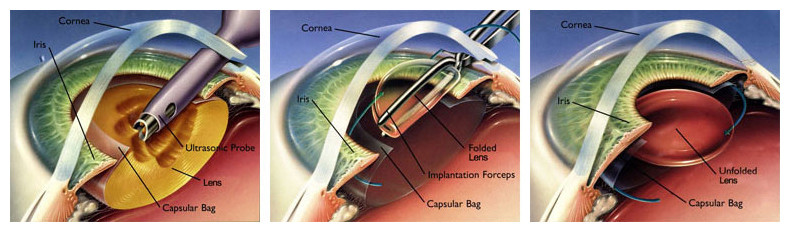
The procedure is similar to iLASIK and both eyes can be treated on the same day. Anesthetic eye drops are used to numb the eye and a mild sedative is administered. Through a 3mm corneal incision, a circular opening is created in the lens capsule and a small ultrasound instrument is used to break up and remove the human lens material. The artificial lens is then injected through the small incision and placed inside the lens capsule, which will seal around the lens implant locking it in place. The incision seals without stitches and the entire procedure takes about 10 minutes per eye. There is a mild pressure sensation but no pain during the surgery. Vision can be blurry immediately afterwards and patients are encouraged to go home and rest for the remainder of that day. Most people are seeing well enough the next day to resume full activity, including driving and working.
- Refractive Lens Replacement
I recently had refractive lens replacement performed by Dr. Oursler. He was highly recommended by my optometrist specifically due to his experience, and state-of-art knowledge and equipment. My entire experience with Dr. Oursler and his staff was awesome. They were all friendly, professional and gave me a thorough evaluation to see if I was a candidate for the procedure performed. The entire experience was positive. timely, and painless! I was given detailed explanations, every step of the way, and also highlighted, organized instructions for follow-up care. I couldn't be more happy about the results and highly recommend Dr. Oursler.

- Knowledgeable, Courteous & Helpful
Dr. Oursler performed iLASIK on me a week ago. The pre-op meeting went well and the meeting with Dr. Oursler was a learning experience. The surgery went with Dr. Oursler explaining each step. His staff was knowledgeable, courteous, and very helpful before, during, and after the surgery. My post-op appointment with Dr. Oursler went well and he continued to answer questions.
- Best Money Ever Spent
Dr. Oursler performed Lasik surgery for my husband 15 years ago. He still thinks it's the best money he's every spent! He did mine recently too, and I agree 100%. Love Dr. Oursler and Graystone Eye!